
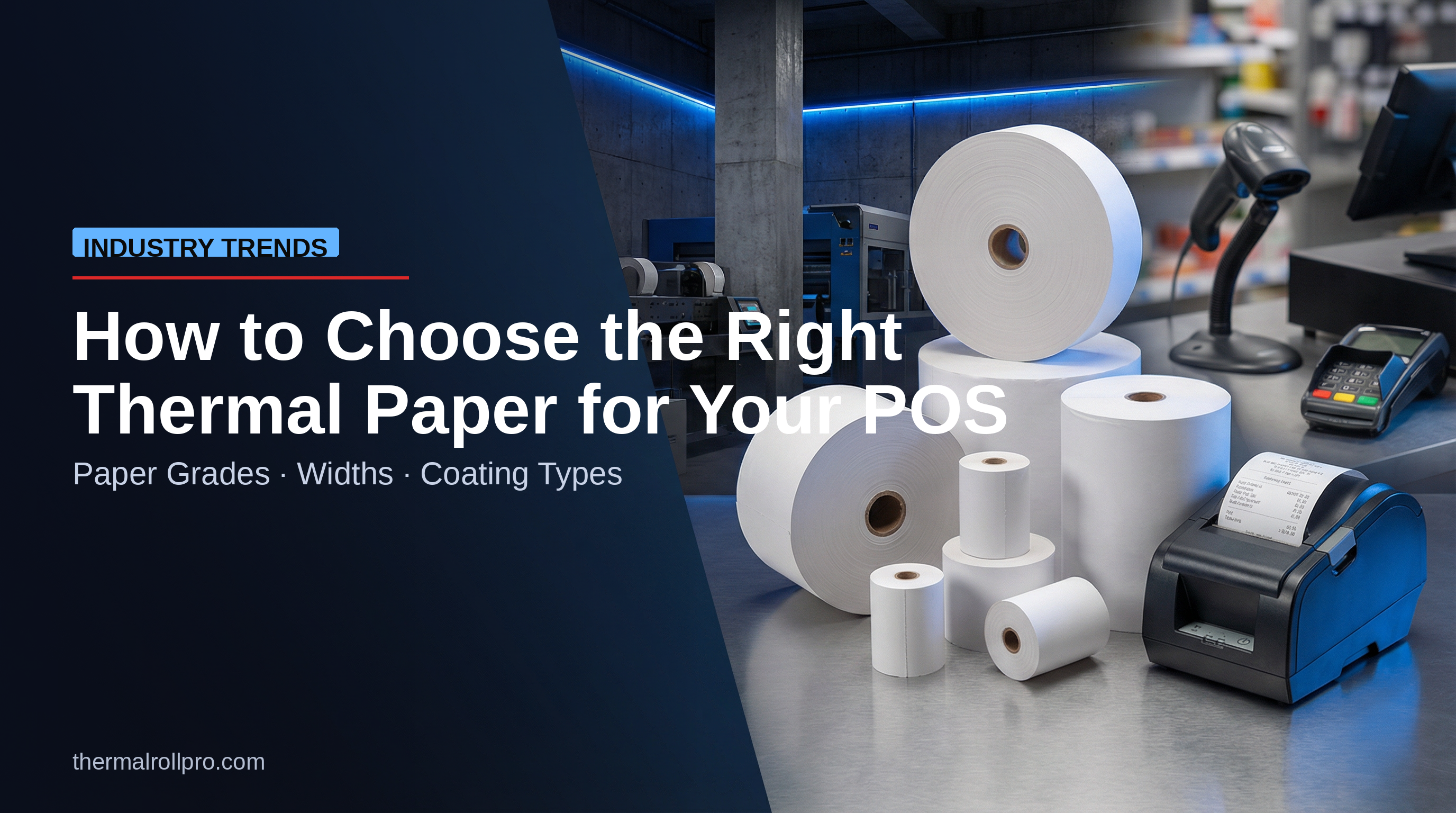
Choosing the right thermal paper for your POS system is more important than most business owners realize. The wrong paper can cause faded receipts, paper jams, incompatible roll sizes, or even void your printer warranty. This guide covers everything you need to know to make the right choice.
Why Thermal Paper Selection Matters
Thermal paper works through a chemical reaction: heat from your printer's thermal head activates a coating on the paper, producing the text and graphics on your receipt. The quality of that coating — and the physical dimensions of the roll — determines print clarity, image longevity, and printer compatibility.
Using the wrong paper can result in:
- Faded or illegible receipts within weeks of printing
- Paper jams caused by incorrect roll width or core size
- Printer head damage from abrasive or chemically incompatible coatings
- Compliance issues if the paper contains BPA and your business operates in a regulated industry
Step 1: Match the Roll Size to Your Printer
The most critical specification is the roll width. Common POS printer widths include:
| Width | Common Printers | Typical Use |
|---|---|---|
| 57mm (2¼") | Moneris iWL220, Verifone Vx820, Ingenico iCT220 | Payment terminals, handheld POS |
| 80mm (3⅛") | Epson TM-T88, Star TSP100, Bixolon SRP-350 | Full-size receipt printers |
| 76mm (3") | Older cash registers, some ATMs | Legacy systems |
Beyond width, check the outer diameter (OD) and core diameter:
- Most desktop POS printers accept rolls up to 80mm OD
- Core diameter is typically 12.7mm (½") or 25.4mm (1")
- Coreless rolls (no cardboard core) are available for some terminal models
Tip: Check the existing roll in your printer — the width, OD, and core size are usually printed on the wrapper or embossed on the core.
Step 2: Choose the Right Coating
Thermal paper coatings vary significantly in quality and chemical composition:
Standard Thermal Coating The most common type. Produces clear, dark prints. Image life is typically 5–7 years under normal storage conditions (away from heat, UV light, and plasticizers).
High-Sensitivity Coating Requires less heat to activate, which reduces wear on the printer head and extends its lifespan. Recommended for high-volume environments like busy restaurants or retail counters.
BPA-Free / Phenol-Free Coating Replaces bisphenol A (BPA) with safer chemical developers. Health Canada has classified BPA as a toxic substance, and many Canadian retailers (including Loblaw and Costco Canada) have already mandated BPA-free paper. For food service, healthcare, and any business with high receipt-handling frequency, phenol-free paper is the recommended choice.
Top-Coated Paper Has an additional protective layer that improves resistance to moisture, oils, and UV light. Ideal for receipts that need to remain legible for extended periods (warranties, parking tickets, medical records).
Step 3: Verify BPA-Free Status
If you are purchasing BPA-free paper, do not rely solely on the label. Ask your supplier for:
- Third-party test certificate from SGS, Intertek, or Bureau Veritas confirming BPA/BPS-free status
- EU REACH compliance — EU regulations restrict BPA in thermal paper to 0.02% by weight
- FDA compliance (21 CFR) — confirms the paper meets US food-contact material standards
- Safety Data Sheet (SDS) identifying the thermal developer used
Step 4: Consider Print Image Life
How long does the print need to remain legible? This affects which paper grade you should choose:
| Application | Recommended Image Life | Paper Grade |
|---|---|---|
| Daily receipts (customer copy) | 2–5 years | Standard |
| Merchant copy (records) | 5–10 years | Premium / top-coated |
| Warranty receipts | 7–10 years | Premium top-coated |
| Medical / legal documents | 10+ years | Archival grade |
Standard thermal paper stored in a cool, dry location away from direct sunlight will typically retain legibility for 5–7 years. Exposure to heat, UV light, plasticizers (from plastic bags or folders), or oils accelerates fading.
Step 5: Calculate Your Order Quantity
Ordering the right quantity saves money on shipping and ensures you never run out during a busy period. To calculate:
- Count your daily transactions (or estimate from your POS system reports)
- Estimate receipt length (typically 15–30cm per transaction)
- Calculate daily paper consumption in meters
- Divide the roll length (in meters) by daily consumption to get rolls per day
- Multiply by your desired stock period (30, 60, or 90 days)
For example: 200 transactions/day × 20cm = 40m/day. A 57mm × 50' (15m) roll lasts 15 ÷ 40 = 0.375 days, so you need approximately 3 rolls per day, or 90 rolls per month.
Frequently Asked Questions
Q: Can I use any brand of thermal paper in my Epson TM-T88? A: Yes, as long as the roll dimensions match (80mm width, correct OD and core size). Epson does not require proprietary paper. However, using low-quality paper with abrasive coatings can accelerate thermal head wear.
Q: What is the difference between 80×80mm and 80×70mm rolls? A: Both are 80mm wide, but the outer diameter differs: 80×80mm has an 80mm OD (approximately 80m of paper), while 80×70mm has a 70mm OD (approximately 60m). Both fit 80mm-wide printers. Choose based on your printer's paper compartment depth.
Q: How do I know if my thermal paper is BPA-free? A: Ask your supplier for a third-party test certificate. A quick field test: apply brief heat to the paper — BPA-containing paper typically turns solid black, while phenol-free paper often turns a slightly different shade. This test is indicative but not definitive.
Q: Why are my receipts fading quickly? A: Common causes include: storing rolls near heat sources, exposure to UV light, contact with plasticizers (plastic bags, PVC folders), or using low-quality paper with insufficient coating weight. Switch to a premium or top-coated grade for better longevity.
ZhixinPaper manufactures BPA-free and phenol-free thermal paper rolls for POS systems, payment terminals, and receipt printers. We supply distributors and office supply companies in Canada, the United States, and internationally. Contact us [blocked] for samples and bulk pricing.


