Introduction
Every time a cashier hands you a receipt, a logistics worker scans a shipping label, or a parking attendant issues a ticket, thermal paper roll printing is at work. Unlike conventional printing that relies on ink, toner, or ribbons, thermal printing produces sharp, durable images using nothing more than controlled heat. For procurement managers, retail operators, and distributors sourcing paper rolls at scale, understanding how this technology works — and what separates a quality roll from a substandard one — directly affects operational reliability, cost efficiency, and compliance.
This guide walks through the complete picture: the chemistry behind thermal paper, the step-by-step manufacturing and printing process, key specifications to evaluate, and what to look for when sourcing custom-printed or BPA-free thermal rolls from a factory supplier.
What Is Thermal Paper?
Thermal paper is a specialty paper coated with a heat-sensitive chemical layer. When heat is applied to specific areas of the surface — by a thermal printhead — a chemical reaction occurs that darkens those areas and forms a visible image. No ink, no ribbon, no toner cartridge is involved.
The coating typically consists of three functional layers applied over a base paper substrate:
| Layer | Function |
|---|---|
| Base paper | Provides mechanical strength and dimensional stability; typically 48–80 gsm |
| Pre-coat layer | Smooths the surface and improves adhesion of the thermal layer |
| Thermal (active) layer | Contains the leuco dye and developer that react to heat to produce the image |
| Top coat (optional) | Protects the image from moisture, oil, UV light, and physical abrasion |
The thermal layer is the heart of the product. It contains a leuco dye (a colorless compound that turns dark when oxidized) and an acid developer (typically a phenolic compound or a BPA-free alternative). When the printhead heats a spot to approximately 60–80°C, the developer melts and reacts with the leuco dye, producing a dark mark in milliseconds.
How the Printing Process Works
1. The Thermal Printhead
A thermal printer contains a row of tiny resistive heating elements — the printhead — arranged across the full width of the paper path. Each element corresponds to one dot in the printed output. As the paper rolls past the printhead at a controlled speed, selected elements are energized to produce heat, activating the coating at precise locations.
The resolution of a thermal printer is measured in dots per inch (DPI). Most POS receipt printers operate at 203 DPI, which is sufficient for text and simple barcodes. Label printers used in logistics and healthcare often run at 300 DPI or 600 DPI to produce high-density barcodes and fine print that scanners can read reliably.
2. Direct Thermal vs. Thermal Transfer
It is important to distinguish between two technologies that are often confused:
Direct thermal printing uses heat-sensitive paper directly. The printhead contacts the coated surface, and the image forms through the chemical reaction described above. This is the technology used in most receipt printers, ticket machines, and portable label printers. There is no ribbon or consumable beyond the paper roll itself.
Thermal transfer printing uses a ribbon coated with wax or resin. The printhead melts ink from the ribbon onto a plain or synthetic label substrate. The output is more durable and resistant to heat, chemicals, and UV light, but the running cost is higher due to ribbon consumption.
For high-volume, cost-sensitive applications such as retail POS, food delivery, and parking systems, direct thermal rolls are the dominant choice.
3. Print Speed and Quality Factors
Print quality in direct thermal printing depends on the interaction between the paper coating and the printer hardware. Key variables include:
Sensitivity of the coating. A higher-sensitivity coating activates at lower temperatures, allowing faster print speeds without sacrificing density. This is particularly important for high-throughput POS environments where the printer may produce hundreds of receipts per hour.
Smoothness of the paper surface. The printhead must make uniform contact with the coating. Rough or uneven surfaces create voids in the image — white spots or faded lines — that reduce barcode readability. Surface smoothness is measured by the Bekk smoothness test; premium thermal paper typically achieves values above 400 seconds.
Caliper consistency. Variations in paper thickness cause the paper to feed unevenly, leading to skewed prints or paper jams. A well-manufactured roll maintains caliper tolerance within ±3 µm across the entire width and length.
The Manufacturing Process: From Jumbo Roll to Finished Product
Understanding how thermal paper rolls are made helps buyers evaluate supplier quality claims and production capabilities.
Step 1: Base Paper Production
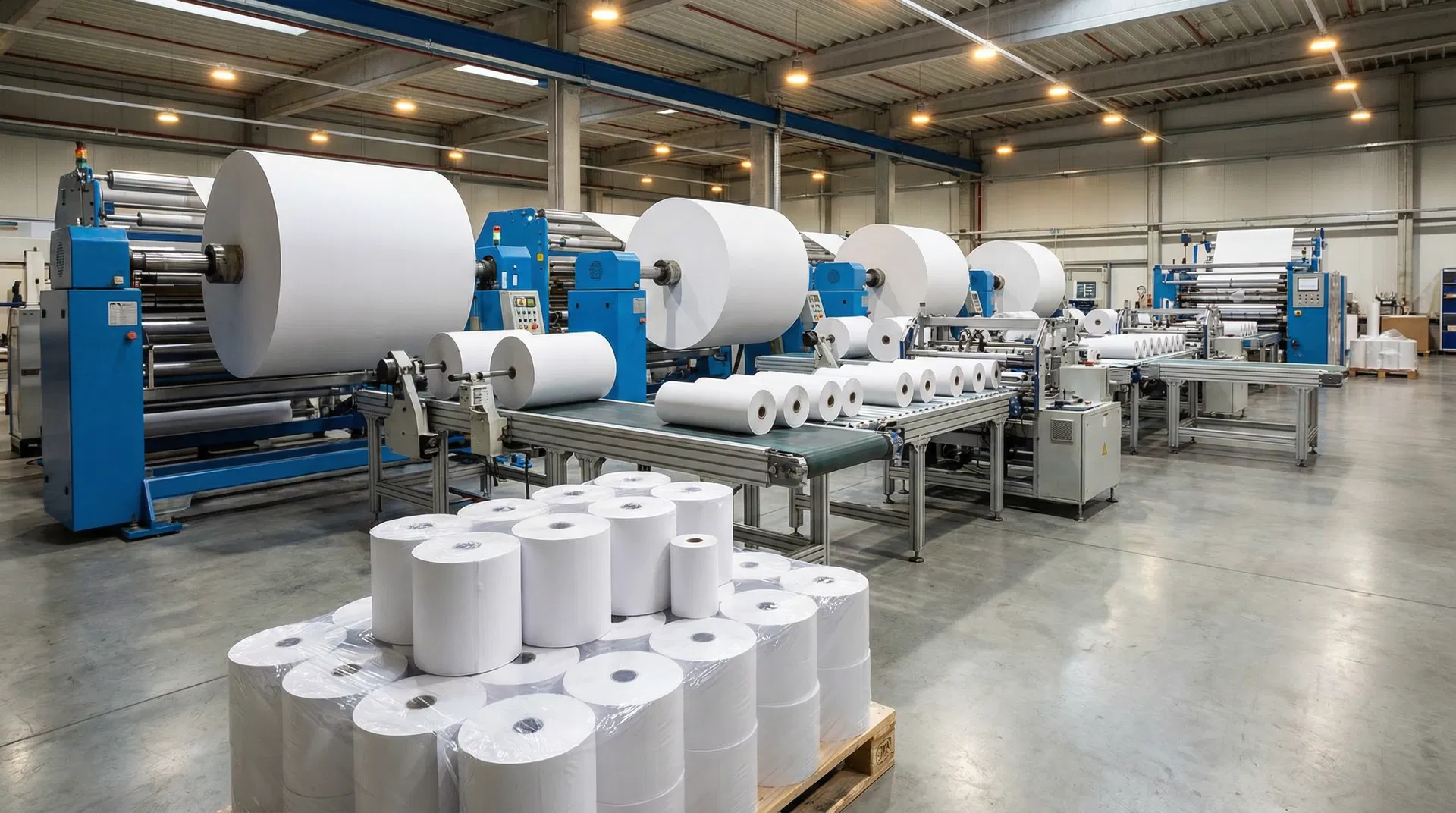
The process begins with a wood-pulp base paper manufactured to precise weight and porosity specifications. The base paper is produced in large jumbo rolls — typically 1,000–1,500 mm wide and several thousand meters long — at a paper mill.
Step 2: Thermal Coating
The jumbo roll is fed through a coating machine that applies the pre-coat, thermal layer, and (optionally) top coat in sequence. Each layer is applied using a precision blade or curtain coater, then dried in a temperature-controlled oven. The coating weight, uniformity, and drying conditions determine the final sensitivity, image density, and shelf life of the paper.
At ZhixinPaper's thermal paper roll manufacturing facility [blocked], our coating lines operate under continuous quality monitoring, with inline sensors measuring coat weight and surface smoothness in real time. This ensures batch-to-batch consistency — a critical requirement for customers running automated POS or labeling systems that cannot tolerate variation.
Step 3: Calendering
After coating and drying, the paper passes through a calendering stack — a series of polished steel rollers under high pressure. Calendering compresses the surface to achieve the target smoothness and caliper, and improves the uniformity of the thermal layer.
Step 4: Slitting
The coated jumbo roll is then transferred to a slitting machine, which cuts it into rolls of the required width (e.g., 57 mm, 80 mm, 110 mm) and winds them onto cores of the specified inner diameter (typically 12 mm or 25 mm). The slitting process must produce clean, burr-free edges; rough edges cause paper jams and uneven feeding in printers.
Our facility operates 15 high-speed slitting machines with a combined capacity of over 200,000 rolls per day, enabling reliable fulfillment of large-volume orders without lead time surprises.
Step 5: Pre-Printing (Optional)
For customers requiring custom-printed rolls — with a logo, promotional message, or regulatory text printed on the back or front of the paper — a flexographic printing step is inserted before or after slitting. Flexographic printing uses fast-drying, water-based inks applied via engraved rubber plates. Up to four colors can be applied in a single pass.
Custom printing is particularly popular among retailers who use the back of receipts for loyalty program promotions, QR codes linking to review platforms, or brand messaging. It is also required in some markets for receipts to carry regulatory information such as return policy notices or tax identification numbers.
Step 6: Quality Inspection and Packaging
Finished rolls undergo a series of quality checks before packaging:
- Image density test: A test print is produced and measured with a densitometer to verify that the coating activates correctly and produces consistent black density.
- Sensitivity test: The roll is exposed to a calibrated heat source to confirm activation temperature falls within specification.
- Dimensional check: Width, outer diameter, inner diameter, and roll length are verified against order specifications.
- Visual inspection: Rolls are checked for surface defects, edge quality, and correct winding tension.
Rolls that pass inspection are packaged in shrink wrap or polybag, then packed into cartons for export. Packaging can be customized with private labels, barcodes, or retail-ready display packaging upon request.
Key Specifications for Procurement
When sourcing thermal paper rolls, the following specifications define compatibility with your printers and suitability for your application:
| Specification | Common Values | Notes |
|---|---|---|
| Width | 57 mm, 76 mm, 80 mm, 110 mm | Must match printer paper path width |
| Roll length | 30 m, 50 m, 80 m, 100 m | Longer rolls reduce change frequency |
| Core inner diameter | 12 mm, 25 mm | Must match printer core holder |
| Outer diameter | 40–80 mm | Determines roll capacity; check printer max OD |
| Paper weight (gsm) | 48, 55, 58, 65, 80 gsm | Heavier paper = stiffer, more durable |
| Sensitivity | Standard, High | High sensitivity for fast printers |
| Top coat | None, water-resistant, oil-resistant | Required for kitchen, outdoor, or archival use |
| Chemical compliance | BPA-free, BPS-free, Phenol-free | Required for EU, US food-contact applications |
BPA-Free Thermal Paper: Why It Matters
Bisphenol A (BPA) was historically used as the acid developer in thermal paper coatings because of its effectiveness and low cost. However, BPA is classified as an endocrine disruptor, and studies have shown that it can be absorbed through skin contact — a concern for cashiers who handle receipts throughout the working day.
Regulatory pressure has accelerated the transition to BPA-free alternatives:
- The European Union banned BPA in thermal paper under REACH regulations (effective January 2020), and has since extended restrictions to BPS (bisphenol S), another common substitute.
- France banned BPA in all food-contact materials, including receipts, in 2015.
- Several US states have enacted or are considering similar restrictions.
At ZhixinPaper, all of our thermal paper rolls [blocked] are manufactured using phenol-free developer systems — free of both BPA and BPS. This ensures compliance with current EU REACH requirements and positions our customers ahead of anticipated regulatory changes in other markets.
Custom Printing: What Buyers Should Know
Custom-printed thermal rolls offer a cost-effective way to reinforce brand identity at every customer touchpoint. Here is what to consider when placing a custom printing order:
Artwork requirements. Flexographic printing works best with vector artwork (AI, EPS, or high-resolution PDF). Fine gradients and photographic images are not suitable for flexo; logos, text, and simple graphics reproduce well.
Color limitations. Standard flexographic printing supports up to 4 spot colors. Full-color process printing (CMYK) is possible but adds cost and complexity. Most custom receipt rolls use 1–2 colors.
Minimum order quantities. Custom printing requires plate production, which adds a one-time setup cost. MOQs for custom-printed rolls are typically higher than for blank rolls — commonly 5,000 to 10,000 rolls per SKU, depending on the roll size and number of colors.
Lead time. Allow 2–3 weeks for plate production and first-run approval. Repeat orders can typically be fulfilled within the standard production lead time.
Print placement. Printing can be applied to the back of the paper (non-thermal side), the front (thermal side, in areas that will not be overprinted by the printer), or both. Back printing is most common and does not affect print quality.
Choosing a Reliable Thermal Paper Roll Supplier
For distributors and procurement managers sourcing at volume, supplier reliability is as important as product quality. Key criteria to evaluate include:
In-house manufacturing. A supplier that owns its coating and slitting lines — rather than trading finished goods — has direct control over quality, lead times, and pricing. Ask for a factory audit or video tour.
Batch consistency. Request test rolls from multiple production batches and run them on your target printers. Inconsistency between batches is a common source of field complaints.
Certifications. Look for ISO 9001 quality management certification, and request test reports for BPA/BPS content, image density, and archival stability. For food service applications, confirm compliance with FDA 21 CFR or EU food-contact regulations.
Export experience. A supplier with established export logistics can handle customs documentation, proper packaging for sea freight, and compliance with destination-country labeling requirements. Ask for references from customers in your target market.
Sampling policy. A confident manufacturer will provide free or low-cost samples before you commit to a bulk order. Be cautious of suppliers who are reluctant to provide samples.
Conclusion
Thermal paper roll printing is a mature, well-understood technology — but the quality of the output depends entirely on the precision of the manufacturing process behind it. From the chemistry of the coating to the accuracy of the slitting and the consistency of the finished roll, every step in the production chain affects how reliably your printers perform and how long your printed records remain legible.
Whether you are sourcing blank receipt rolls for a retail chain, custom-printed rolls for a branded customer experience, or BPA-free rolls to meet regulatory requirements, working with a factory manufacturer that controls the full production process gives you the transparency, consistency, and flexibility that trading companies cannot match.
ZhixinPaper [blocked] has manufactured thermal paper rolls since 2009, supplying distributors and enterprise buyers in over 30 countries. Our factory operates 4 coating lines and 15 slitting machines, with a daily output exceeding 30 tons. We offer OEM custom printing, private label packaging, and free samples for qualified buyers.
Request a free sample or get a quote → [blocked]
Frequently Asked Questions
Q: How long do thermal paper prints last? Standard thermal paper without a top coat typically retains readable images for 5–7 years under normal storage conditions (away from heat, light, and chemicals). Top-coated paper can extend archival life to 10–25 years. For applications requiring long-term record retention (e.g., medical receipts, legal documents), specify a top-coated grade.
Q: Why does thermal paper turn black when exposed to heat? The thermal coating contains a leuco dye and an acid developer. At room temperature, these components are separated by a binder matrix and the dye remains colorless. When heat is applied, the binder melts, the developer and dye come into contact, and an acid-base reaction converts the dye to its colored form — producing the dark image.
Q: Can thermal paper be recycled? Thermal paper is technically recyclable as paper fiber, but the chemical coating complicates the process. Many recycling facilities ask that thermal paper be separated from other paper streams. BPA-free and phenol-free thermal paper is generally considered more environmentally acceptable, and some grades are certified for composting or de-inking.
Q: What is the difference between 55 gsm and 80 gsm thermal paper? Heavier paper (higher gsm) is stiffer, more resistant to tearing, and produces a more premium feel. It also tends to have better dimensional stability in humid environments. Lighter paper (lower gsm) reduces roll weight and cost, which matters for high-volume applications where paper cost per transaction is a key metric. Most retail POS applications use 55–58 gsm; premium receipt applications or applications requiring durability use 65–80 gsm.
Q: What is the minimum order quantity for custom-printed thermal rolls? MOQ depends on roll size and number of print colors. For standard sizes (57×40 mm, 80×80 mm), MOQ for custom-printed rolls typically starts at 5,000 rolls. Contact us for a specific quote based on your requirements.


